 February 12, 2026 06:51
Clinical pathways for managing paediatric auditory health in the Singaporean context
The ability to perceive sound is a critical component of a child’s neurological and social development. When a child faces hearing challenges, the path to resolution requires a meticulous clinical approach led by experienced medical professionals. In Singapore, the healthcare system is designed to provide families with a seamless transition from the initial detection of a hearing issue to the implementation of a long-term management plan. Because the causes of hearing impairment vary significantly—from simple fluid accumulation to complex inner ear conditions—the expertise of an ear specialist Singapore is essential for ensuring an accurate diagnosis. This article examines the clinical procedures used to assess childhood hearing, the various treatment options available, and the importance of sustained rehabilitative support.
Key Takeaways
-
Accurate diagnosis is the cornerstone of effective hearing management in young children.
-
Middle ear issues are often temporary but require medical oversight to prevent developmental delays.
-
Modern audiological testing allows for precise measurements of hearing sensitivity even in non-verbal infants.
-
Permanent hearing loss is managed through a combination of high-fidelity technology and targeted therapy.
-
Long-term success is achieved through a partnership between clinical experts, educators, and the family unit.
The diagnostic process and the role of clinical expertise
When a parent or educator notices that a child is not responding appropriately to sound or is experiencing delays in speech, the first step is a comprehensive audiological evaluation. An ear specialist Singapore begins this process by conducting a physical examination of the ear canal and eardrum. This initial check is vital for ruling out conductive barriers, such as impacted earwax or a perforated eardrum, which can often be treated through minor medical procedures.
Following the physical exam, the clinical team employs a variety of objective and behavioural tests. For younger children, tympanometry is frequently used to assess the function of the middle ear and the mobility of the eardrum. If there is evidence of fluid behind the drum—a common occurrence in paediatric patients—the specialist will determine if the fluid is likely to resolve on its own or if surgical intervention, such as the placement of ventilation tubes, is required. By accurately identifying the source of the hearing barrier, the medical team can provide a clear and effective roadmap for recovery.
Objective testing methods for infants and young children
Testing the hearing of an infant requires specialised technology that does not rely on the child’s active participation. In Singapore, audiologists utilise Otoacoustic Emissions (OAE) and Auditory Brainstem Response (ABR) tests to gather data on the health of the inner ear and the auditory nerve. During an OAE test, a small probe is placed in the ear to measure the echoes produced by the hair cells in the cochlea in response to sound. A lack of these echoes can indicate a sensorineural hearing loss.
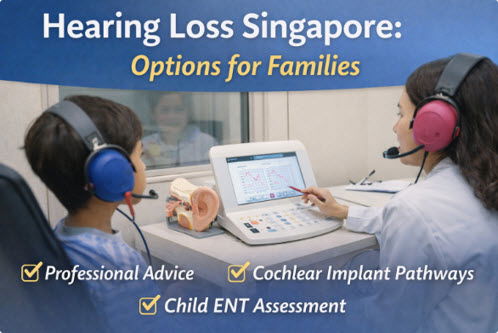
The ABR test is even more detailed, involving the placement of sensors on the child’s forehead and behind the ears to track electrical activity in the brain as sounds are played. These tests are usually performed while the child is asleep or very quiet, providing a highly accurate baseline of their hearing sensitivity across different frequencies. For families, these objective results are invaluable, as they remove the guesswork from the diagnostic process and allow the ear specialist Singapore to recommend specific interventions with a high degree of confidence.
Managing permanent sensorineural hearing loss with technology
In cases where the hearing loss is found to be sensorineural and permanent, the clinical focus shifts toward amplification. Digital hearing aids are the primary tool for most children, and modern devices are equipped with sophisticated sound processing that can be tailored to the child's specific environment. The goal is to provide enough amplification for the child to hear speech clearly while ensuring that loud sounds are not uncomfortable or damaging.
The fitting of these devices is a precise task that requires regular follow-up. As the child’s ear canal grows, the ear moulds must be replaced to maintain a proper seal and prevent feedback. Furthermore, the digital settings of the hearing aids are adjusted as the child grows older and provides more feedback about their listening experience. This ongoing care ensures that the child has the best possible access to the auditory world, allowing them to develop the communication skills necessary for future success.
Advanced surgical options for profound hearing impairment
For children who have a profound hearing loss and do not receive sufficient benefit from traditional hearing aids, surgical solutions are often the next step in the clinical pathway. Singapore is a leading centre for the evaluation and fitting of a cochlear implant Singapore, a device that uses electrical stimulation to provide a sense of sound to those with severe nerve deafness. This surgical option is typically considered when a child is not meeting their auditory milestones despite consistent use of high-power hearing aids.
The candidacy process for an implant involves a multidisciplinary team, including ENT surgeons, audiologists, and speech-language pathologists. They assess the child’s anatomy through MRI or CT scans and evaluate the family’s commitment to the post-surgical rehabilitation process. In Singapore, early implantation is a priority, as it allows the child to take advantage of the brain’s natural plasticity during the critical years of language acquisition. The transition to an implant is a life-changing event that opens new doors for the child’s communicative and social development.
The importance of auditory-verbal therapy and rehabilitation
Access to sound is only the first half of the journey; the second half is learning how to use that sound to communicate. Auditory-verbal therapy (AVT) is a specialised form of rehabilitation that focuses on developing spoken language through listening. In Singapore, AVT is a family-centred approach where parents are taught how to encourage their child’s listening skills throughout the day. By turning everyday interactions into learning opportunities, parents help their child bridge the gap between their chronological age and their "hearing age."
This rehabilitative phase is a long-term commitment that requires patience and persistence. Speech therapists work with the child to improve their sound discrimination, vocabulary, and sentence structure. Regular progress assessments are conducted to ensure the child is meeting their goals and to adjust the therapy plan as needed. The ultimate objective is for the child to enter the school system with the language skills necessary to participate fully in a mainstream classroom alongside their hearing peers.
Establishing a long-term partnership for auditory wellness
The management of paediatric hearing loss is an ongoing process that continues throughout the child’s educational years. As the child moves into primary and secondary school, their listening needs will change, requiring updates to their technology and potentially additional support in the classroom. Regular check-ups with an ear specialist Singapore ensure that the child’s ear health remains stable and that any new issues are addressed promptly.
Singapore offers a robust support network for families, including parent support groups and educational resources provided by the Ministry of Education. By staying engaged with this network and maintaining a strong relationship with their clinical team, parents can navigate the complexities of hearing loss with clarity and confidence. The journey to auditory wellness is a marathon, not a sprint, but with the right professional guidance and a dedicated support system, every child has the opportunity to achieve a future filled with clear communication and connection.
Read another Article: Enhancing paediatric development through specialised ear nose and throat care in Singapore
Posted February 12, 2026 06:51
 ear specialist Singapore
 Reply
Reply RSS Feed
Recent Blog Entries
Tags
Archive
- August 2026
- July 2026
- June 2026
- May 2026
- April 2026
- March 2026
- February 2026
- August 2025
- July 2025
- June 2025
- May 2025
- April 2025
- March 2025
- February 2025
- January 2025
- December 2024
- November 2024
- October 2024
- September 2024
- August 2024
- July 2024
- June 2024
- May 2024
- April 2024
- March 2024
- February 2024
- January 2024
- December 2023
- November 2023
- October 2023
- September 2023
- August 2023
- July 2023
- June 2023
- May 2023
- April 2023
- March 2023
- February 2023
- January 2023
- December 2022
- November 2022
- October 2022
- September 2022
- August 2022
- July 2022
- June 2022
- May 2022
- April 2022
- March 2022
- February 2022
- January 2022
- December 2021
- November 2021
- October 2021
- September 2021